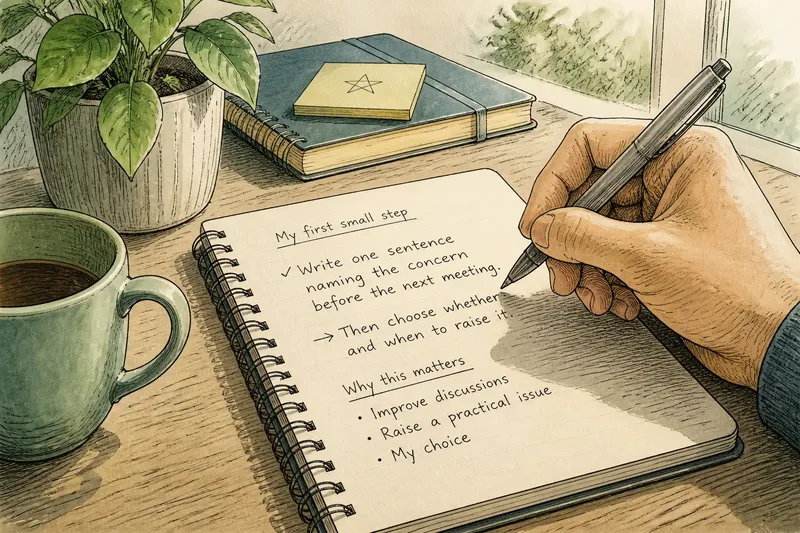
Feedback Is Not a Verdict
Feedback is not a verdict: separate what you observed from what you inferred, then invite a response that helps turn judgement into a useful next step.
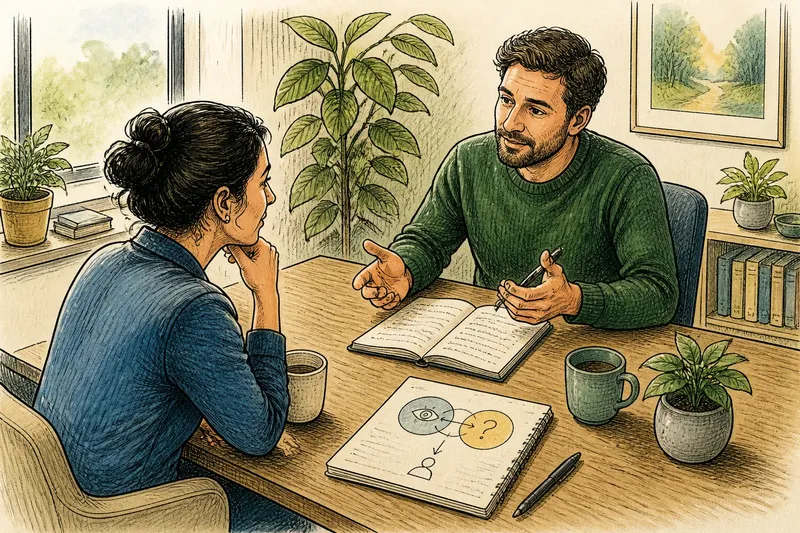
Feedback works best when you separate what you observed from what you think it means. In a coaching conversation, feedback is not a verdict about someone’s character; it is a specific observation offered for discussion, with room for the other person to correct your account.
“You are not committed” turns an interpretation into a label. “You moved the meeting, and I wondered whether this goal still mattered to you” names what you noticed and leaves its meaning open. The second version is not automatically right, but both people can examine it.
Practise this distinction across ordinary conversations. Gather a clear observation, offer it as an invitation, listen to the response and agree whether anything should follow. Adapt the approach to the relationship and the other person’s wishes; it is not a script for every conversation.
Choose an observation
Before speaking, note a detail you directly saw or heard: a phrase, an action, a decision or a moment in a conversation. Leave out explanations of why it happened. If you are relying on memory, say so rather than presenting the detail as exact.
“You stopped speaking after I asked about the project” describes an event. “You felt ashamed” assigns an emotion. “You never follow through” makes a sweeping claim and suggests a motive.
- Check whether you can name the words or action; if you can, use that detail, and if you cannot, describe your uncertainty or leave it out.
- Check what was happening just before the moment; if context changes the meaning, include it, and if you do not know the context, ask rather than assume.
- Check whether the observation relates to the agreed coaching purpose; if it does, consider raising it, and if it is only a minor preference, leave it alone.
- Check whether another person could describe the moment differently; if so, present your account as one perspective, and if not, still invite the other person to confirm or correct it.
- Check whether private notes contain only what you need; if they do, keep them discreet, and if they include unnecessary personal detail, remove it.
- Check whether you have enough information to describe a pattern; if you can name specific occasions, do so, and if you cannot, raise one event or wait for clearer context.
A small detail is like a note on a desk: it shows something about one moment, not the whole room. Treat one observation as a starting point, not a complete account of the person.
Separate meaning and fact
Write down the meaning you have attached to the observation, then keep it separate from what happened. This is not a way to dismiss your impression. It helps you see where your direct account ends and your explanation begins.
Say you are coaching someone who arrives without the notes they planned to bring. The observation is that the notes are absent. You might infer that they did not prepare, felt uncertain about the topic or chose another task. Those are possibilities, not details contained in the observation.
Offer an inference as a question: “I wondered whether preparing felt difficult this week. How did it look from your side?” That gives the other person room to explain without having to accept your reading.
Shape the invitation
Keep the invitation brief: name the moment, mark your interpretation as uncertain, then ask how the other person sees it.
For example: “You said you wanted to speak in the planning meeting, and later you told me you stayed quiet. I wondered whether something made it harder in the room. How did you experience that?” The first part gives shared context; the question asks for their account.
A question can still contain a verdict. “Why do you keep avoiding the hard part?” assumes avoidance and repetition. Ask about the event instead: “What was happening for you when the discussion reached that point?” If several observations matter, agree which one to discuss first rather than delivering a list.
Offer feedback openly
Choose a moment when both of you can give the conversation attention. Ask whether the person is willing to hear an observation. “Would it be useful to hear something I noticed?” gives them a choice about timing.
If they agree, state the detail and distinguish your reading from the event. Then pause. Let the other person respond without adding explanations that make it harder to question your account.
Listen for corrections and missing context. They may recall a detail you missed, describe a constraint or say your observation feels inaccurate. Acknowledge what you hear instead of arguing them back towards your first interpretation.
If they would rather not discuss it now, ask whether they prefer another time or want to leave the topic. Respect their answer; feedback is an invitation, not a demand for immediate agreement.
Use the response
Ask a question that lets the person assess the observation: “What fits, and what does not?” or “How does this look from your side?” Avoid steering them towards the explanation you prefer.
Imagine a coachee arrives without notes they had planned to bring. You describe that observation and say you wondered whether preparation had been difficult. They explain that they had agreed to cover an urgent task. You acknowledge that context and ask whether they still want to discuss preparing for the coaching session. If they do, you can explore a workable approach; if they do not, you can leave the topic there. The explanation changes the interpretation, but it does not erase the observation.
Pay attention to feedback about your delivery as well as the event. If the person says your wording felt like a label, take that seriously. You can explain your intention, but that does not settle how the comment landed.
Agree what follows
Ask whether the observation points to anything the person wants to do. They might choose an experiment, revise a goal, request support or decide that no change is needed. The decision belongs with them, within the purpose and boundaries of the coaching relationship.
Make a chosen action clear enough to revisit. “I’ll prepare one question before the next meeting” names an action. “I’ll be more confident” names a desired feeling, but offers less to discuss later. Treat any follow-up as a chance to review the choice, not as a test of character.
Review your practice
After the conversation, reflect privately on what you said and how you listened. Use each check to decide whether to keep the approach or make a repair:
- Check whether you described an event the other person could recognise; if yes, keep that specific wording, and if no, restate the detail more plainly.
- Check whether you marked your interpretation as your own reading; if yes, leave room for their view, and if no, correct the statement before discussing what it means.
- Check whether you asked about timing or permission; if yes, follow the choice they made, and if no, ask whether they still want to discuss the topic.
- Check whether you listened without pushing for agreement; if yes, use the response to shape the next conversation, and if no, acknowledge the pressure and invite them to reconsider the topic on their terms.
- Check whether you agreed on a next action; if yes, revisit it as the person requested, and if no, ask whether they want to choose an action, change focus or leave the matter there.
- Check whether your wording turned an inference into a fact; if it did, name the assumption and offer a more precise version, and if it did not, ask whether your observation still feels accurate to them.
If you need to repair your wording, be direct: “I realised I presented my assumption as fact. I’d like to restate what I observed and hear how you see it.” That gives the other person a chance to respond to a clearer account.
What if they disagree?
What if they reject the observation?
Ask which detail they see differently, then check whether you can describe the event more accurately. If you still disagree, do not treat your recollection as settled fact; decide together whether the topic remains useful.
What if they become upset?
Pause and acknowledge the impact without demanding an explanation. Ask what they need now, such as quiet or a change of topic, and continue only if they want to.
What if the feedback concerns a pattern?
Name the specific occasions you remember instead of using words such as “always” or “never”. Invite the other person to add context or exceptions before discussing what the pattern might mean.
What if I need to correct my wording?
State what you got wrong and offer a more precise version. Leave room for a response instead of defending your intention.
Keep feedback open
Feedback becomes easier to examine when observation and interpretation remain distinct. The observation gives both people something concrete to discuss; the interpretation is a possibility, not a sentence handed down.
For your next coaching conversation, choose one moment you can describe plainly and one question that lets the other person correct your reading. That is the practical heart of feedback that is not a verdict.